
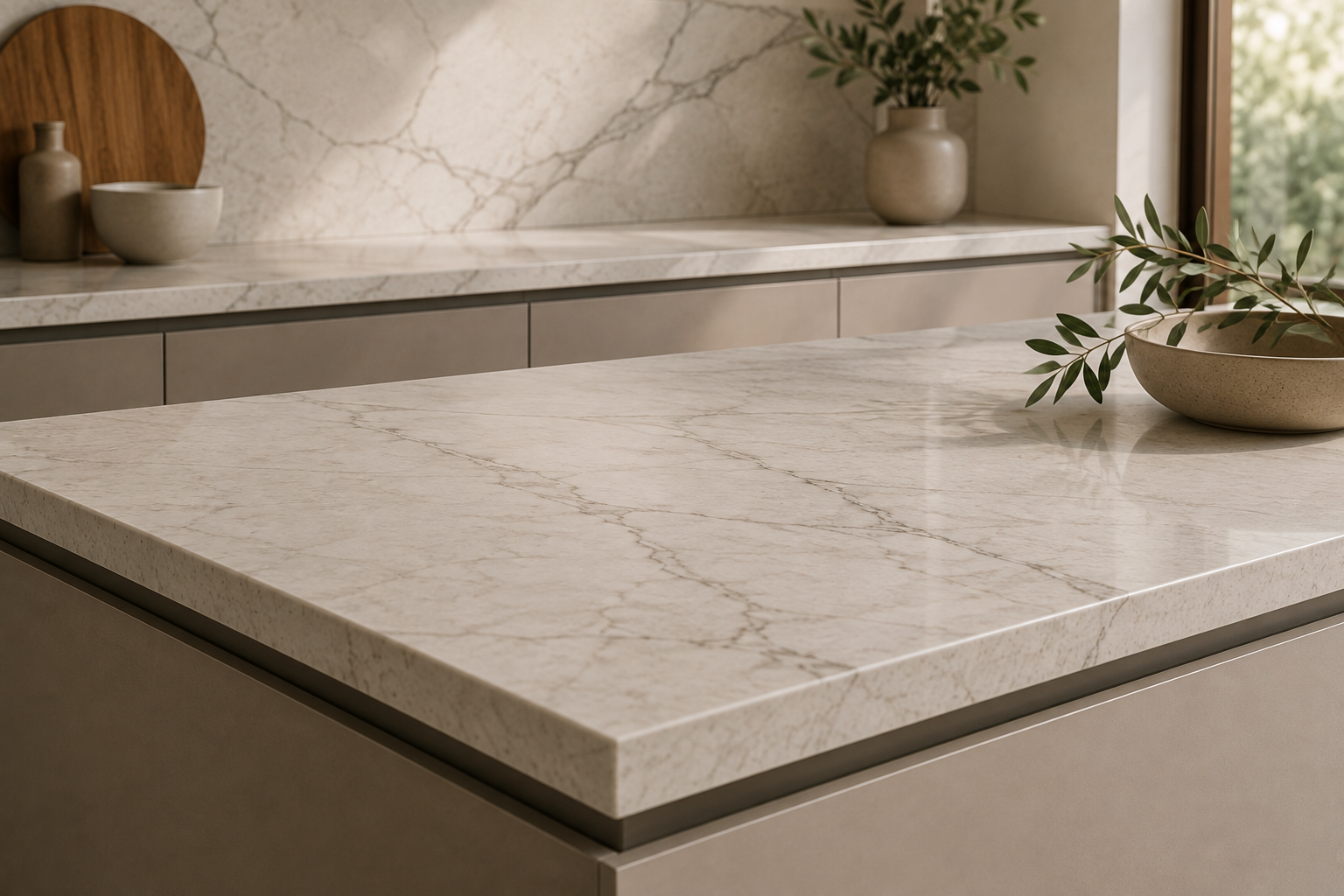
WHAT MATTERS
Marble & Quartz
Natural marble and engineered quartz worktops: how each handles heat, sunlight and staining, sealing and care, edges, seams and what they pair with.
Compare marble and quartz
What matters
Choosing Between Marble and Quartz
- Finish character: every marble slab is different, with veining you choose yourself, while engineered quartz gives you an even, repeatable surface across the whole run
- Climate performance: quartz is non-porous and needs no sealing, natural marble is porous and needs sealing to keep moisture and stains out
- Maintenance: quartz wipes clean with soap and water, marble asks you to deal with acidic spills quickly and to reseal it from time to time
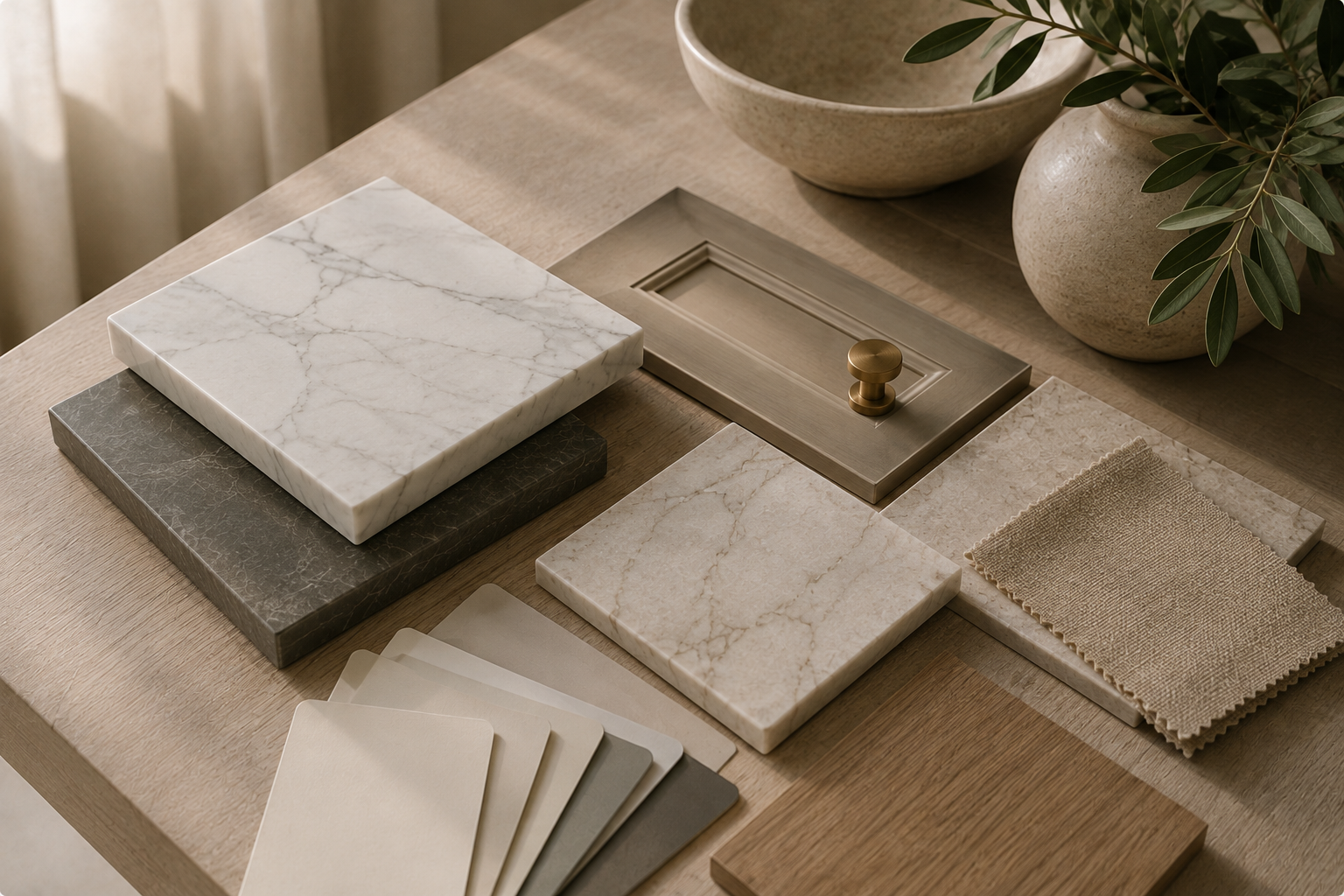
- Pairing with cabinetry: a light marble lifts dark timber fronts, while quartz in an even tone suits flat matt palettes
Feature
Marble or Quartz: What Each One Is Better At
Natural marble: choose it for the stone itself, because no two slabs are alike and the veining is the reason to have it. It takes more looking after, and it rewards that with a surface no factory can repeat|Engineered quartz: choose it for how it behaves. Non-porous, consistent from one end of the run to the other, no sealing, and almost nothing in a kitchen will mark it. What it will not give you is the depth of real stone
Section 03
Sunlight, Heat and Why It Matters Here
Section 04
Stains, Acid Marks and How to Avoid Them
Section 05
Thickness, Edges and Where the Seams Fall
Feature
Waterfall Islands and Full-Height Splashbacks
Stone does more in a kitchen than cover the base units. Carried down the side of an island it turns the run into a single block, which is the detail that makes an island read as a piece of furniture rather than a counter. Taken up the wall instead of a tiled splashback, it removes the grout lines behind the hob entirely, which is the easiest surface in the kitchen to keep clean. Both use more material than a flat worktop, and both look best when the veining is planned across the join.
Section 07
What Stone Pairs With
Spotlight
Why You Pick the Marble Slab Yourself
With engineered quartz, a sample is the product: the slab you get will match it. With natural marble it is not, because no two slabs are the same and the veining you saw on a hand sample may be nothing like the one your worktop is cut from. That is why marble is chosen slab by slab, and why it is worth seeing the actual stone, or at least a full photograph of it, before it is cut. Samples for quartz, slabs for marble.
Most people arrive certain they want marble and leave with quartz on the sink run and marble on the island. That split is not a compromise, it is usually the right answer: the stone you look at and the stone you work on do not have to be the same one.
Ready to choose between marble and quartz?
Tell us the length of each run, where the sink and hob sit, and whether the sink is going under the stone or on top of it. We will come back with which material suits the room, where the seams would fall and what the edge would look like.